
Civility & Civic Leadership in the Circle City: Highlights from the 11th Richard M. Fairbanks Symposium
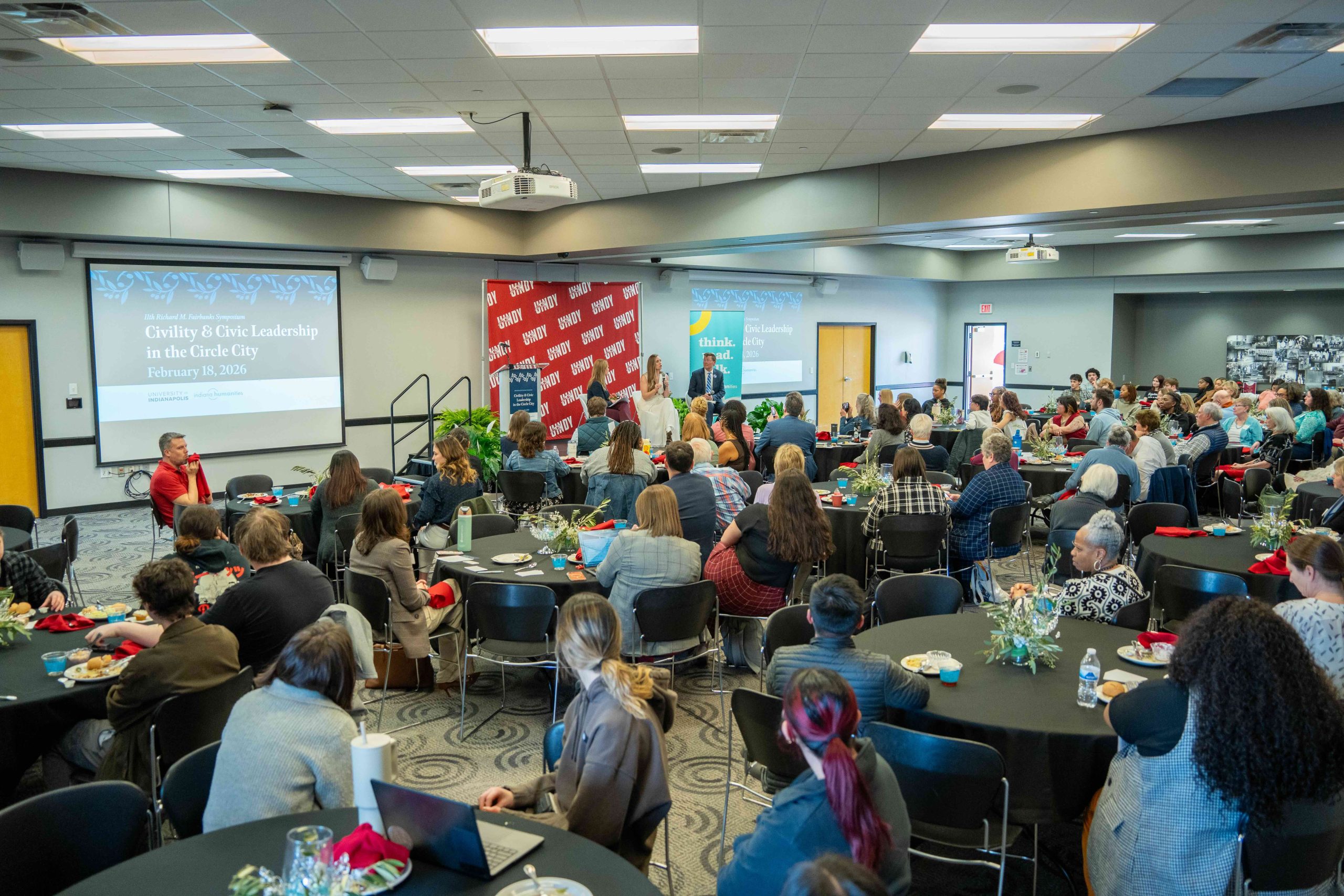
What is civility? How do we practice it? What role does it play in our everyday lives? These are the questions that ethics scholars, political experts, and community members explored together at the 11th Richard M. Fairbanks Symposium: Civility & Civic Leadership in the Circle City.
Hosted by the University of Indianapolis in partnership with Indiana Humanities, the Symposium comes at a time when large majorities of Americans say political rhetoric has gone too far.
“We believe it is our obligation as a university to talk about important issues on a daily basis and we’re proud to organize our community to have these deeper conversations,” said UIndy President Dr. Tanuja Singh. “That’s at the heart of what we call ‘civic engagement’.”
The Symposium also gave UIndy students the opportunity to connect with the Indianapolis community and engage with local civic issues.
“I think it’s important for a university, especially in a city as diverse as Indianapolis, to host events like this, bringing ideas together in one space and then sharing them beyond campus and into the community,” said Nole Marchand ’27 (Archaeology).
Civility in Theory & History
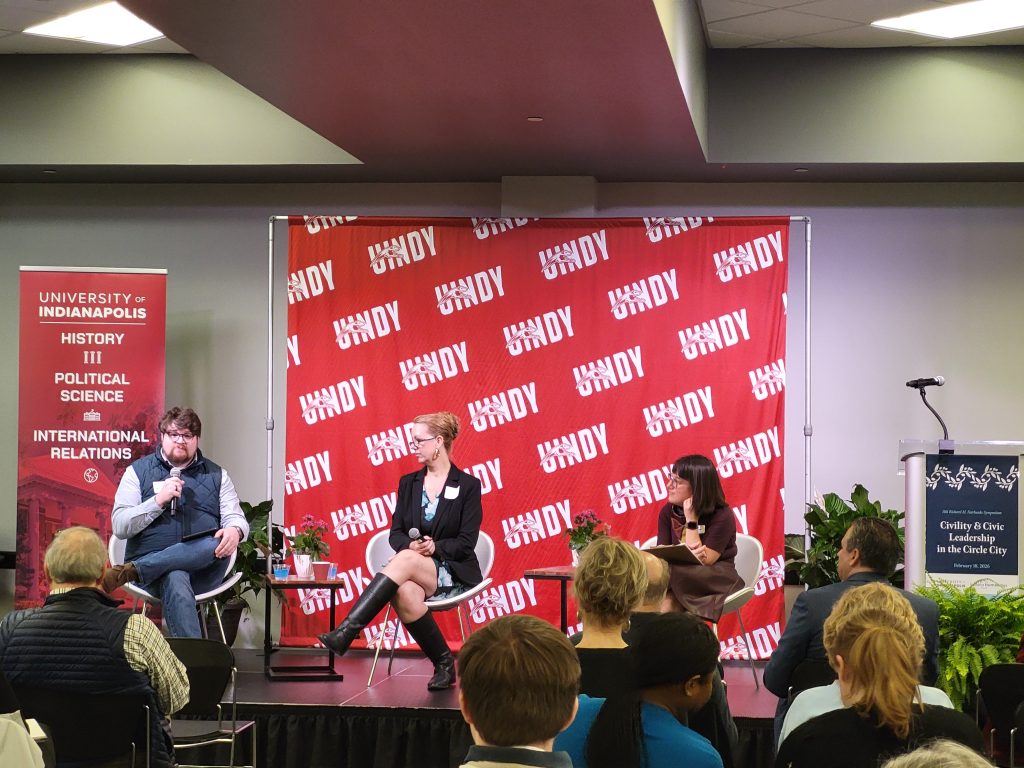
Dr. Alex Richardson, associate director of content strategy and engagement at the Prindle Institute for Ethics at DePauw University, provided the starting point for the Symposium by exploring what civility is and what it is not, an idea that would guide the rest of the day’s discussions.
“Civility is not the absence of conflict,” explained Dr. Richardson. “If civility meant simply avoiding conflict for the sake of peace or parity, it would be pretty useless as a political ideal. Civility is about how we relate to one another as members of a shared political community. It only makes sense in the context of citizens who have to find a way to live together despite, and maybe because of, disagreement.”
Dr. Deborah Mower, director of the Center for Practical Ethics at the University of Mississippi, builds on that definition to connect civility to our everyday lives, not just politics, by framing it as a virtue that everyone must continue to develop.
“One of the most important things about civility as a virtue is that we all have an obligation to develop it,” explained Dr. Mower. “It’s something that only you can develop in these different contexts of life, much like learning to play the piano. You can have a great teacher, but only you can be the one who practices and gets better.”
A Civic Renaissance in Indianapolis
The Symposium’s keynote INconversation, moderated by Dr. Laura Merrifield Wilson, professor of political science at UIndy, shifted the conversation onto the Indianapolis area.
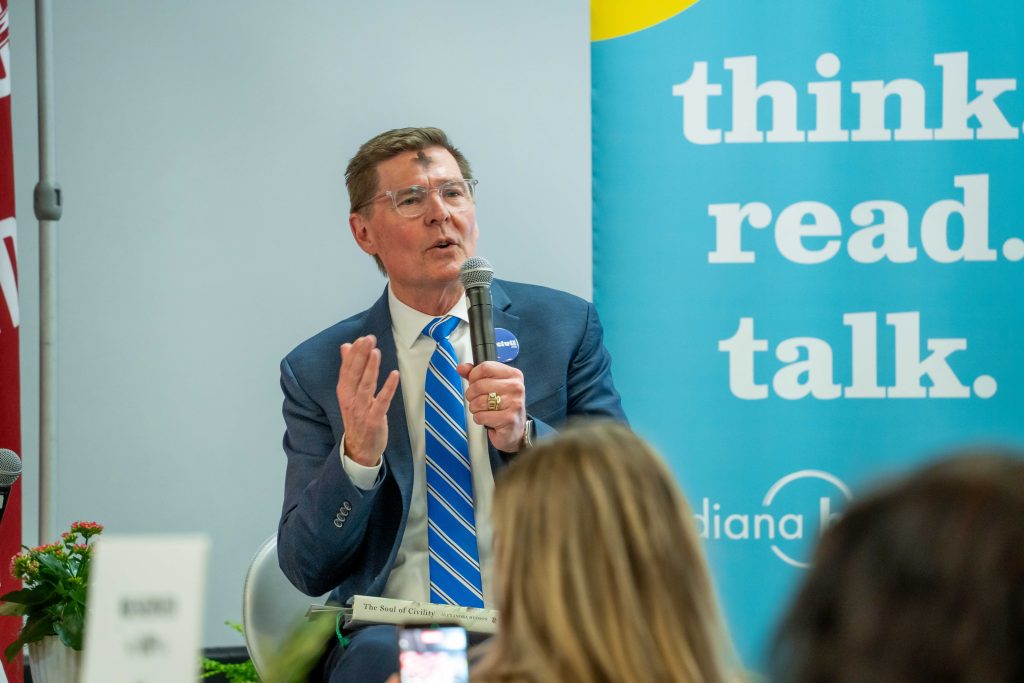
Jeff Worrell, Carmel City Councilman and founder and CEO of the Carmel Civility Foundation, Inc., reflected on his own struggles with civility during his election campaign. When he began his service on the city council, he realized that the only way the culture would change in the future was to model civility now.
“One of the things we’re working on in Carmel is role modeling,” Worrell explained. “I routinely get emails that show very little respect and are just mean, but if I fire back with that same attitude, it devolves. So don’t pick up the bat. Don’t swing back.”
Worrell’s approach to civility was inspired by his fellow keynote speaker Alexandra Hudson, founder of Civic Renaissance, and her book, The Soul of Civility: Timeless Principles to Heal Society and Ourselves. One of the main arguments in the book is that civility and politeness are distinct ideas, similar to Dr. Richardson’s remarks in the first panel, and that civility really comes down to treating each other as human beings.
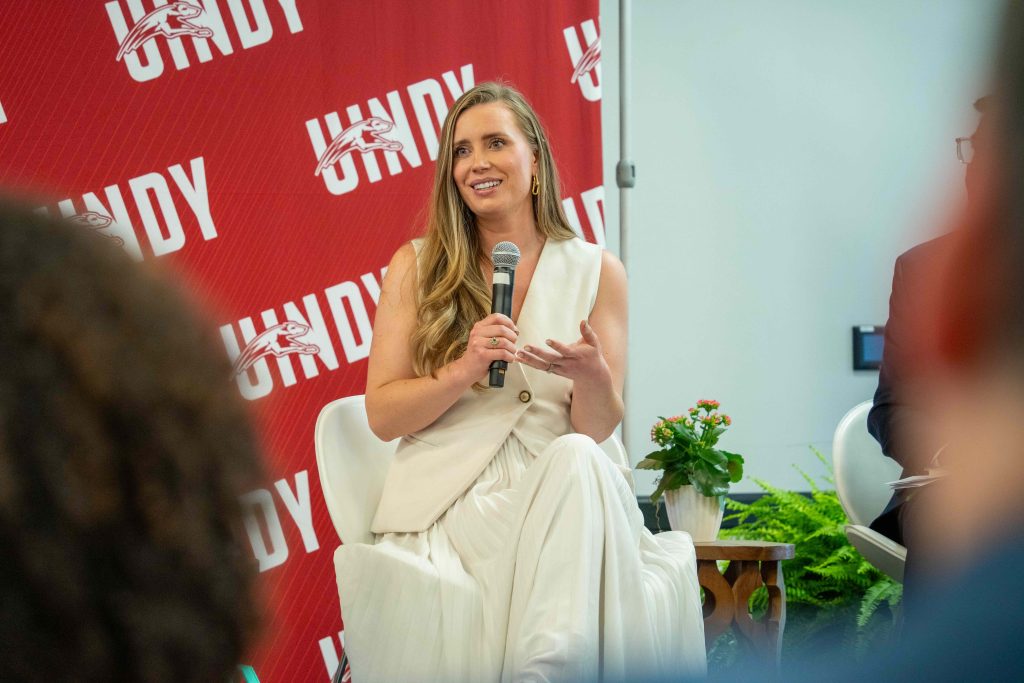
“It’s only true civility that sees other human beings as they really are, beings with irreducible dignity and worth,” said Hudson. “Every single one of us in this room is owed and owes to others a fair minimum of respect, just by virtue of our shared dignity, our equal moral worth as human beings, and that sometimes actually respecting the dignity of others requires being impolite, telling the hard truth, engaging in robust debate.”
Worrell and Hudson’s remarks resonated with the UIndy students in attendance.
“I enjoyed this panel because it highlighted reconciliation, not just in the world of politics, but among us as human beings,” reflected Mira Hagan ’27 (Political Science). “I believe it’s important to operate with the principle of ‘us versus the problem’, not ‘us versus each other.’”
Indiana’s New Civic Health Index and Implications for the Future
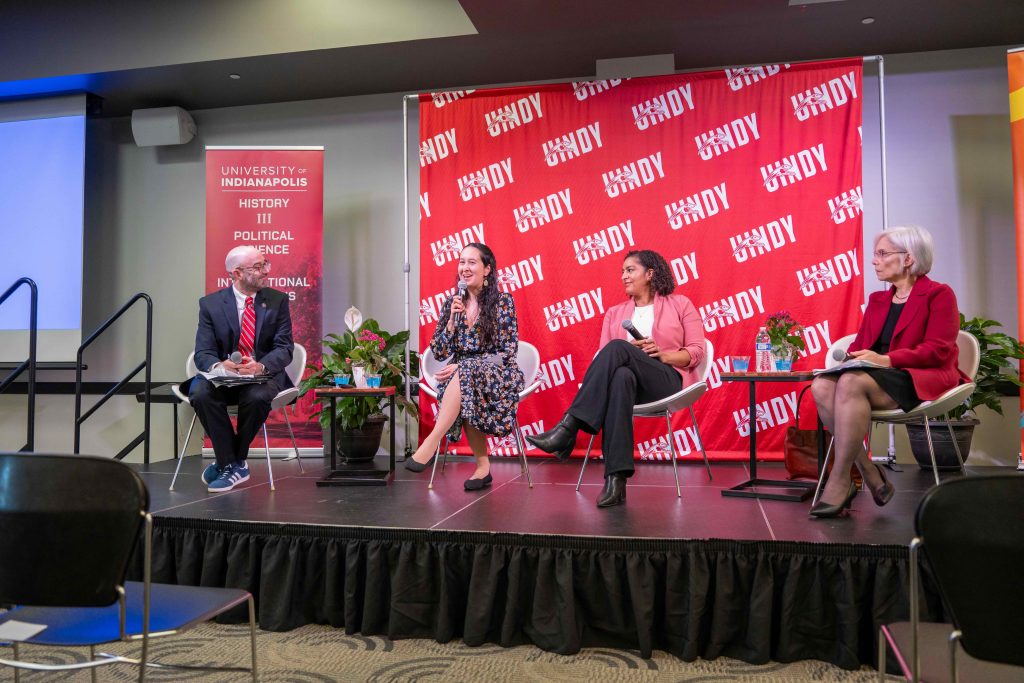
The Symposium closes with an essential question, “Why does civility matter?”
As explained by Dr. Ellen Szarleta, Ph.D., J.D., director of the Center for Urban and Regional Excellence at Indiana University Northwest, the findings in the new Civic Health Index demonstrate that civic health impacts our quality of life in a fundamental way. Communities with strong civic health were shown to have better schools, safer neighborhoods, and more responsive governments.
The Civic Health Index showed improvements to Indiana’s civic health over the past decade. Indiana ranked 19th in the nation for volunteering–up from 32nd– and improved its ranking on “Doing Favors for Neighbors” from 43rd to 28th.
“When we have these conversations, when we look at the data, we know we can affect change,” said Dr. Szarleta. “Sometimes we move backwards, sometimes we can move forwards, but overall, instruments and tools like the Indiana civic health index help us have those conversations and decide what we need to do next.”
So what action can we take to improve our civic health?
Melissa Coe, associate vice president for social impact and community engagement at Eli Lilly Company, encouraged attendees to seek out new perspectives and be open to new ideas.
“Find one person who is different from you in some way, approach them, and be willing to have a conversation,” Coe said. “I know it’s not easy, but I think extending your hand to do that with just one person today is part of the solution. Then from there, just keep doing it.”
Yecenia Tostado, senior program officer for Indiana at the Nina Mason Pulliam Charitable Trust, echoed that encouragement, warning of the dangers of staying in our separate silos.
“I would ask everyone to consider the question, ‘How can we love each other better?’” Tostado said. “It’s so easy to stay in our silos, but to really make progress as a society, we have to break through and be more comfortable in spaces that aren’t comfortable for us.”
As the 11th Richard M. Fairbanks Symposium came to a close, one theme remained clear: civility is not passive, optional, or confined to political spaces. It is a practiced commitment—one that requires listening, humility, and a willingness to engage with those who see the world differently.
“The tools that many of our panelists discussed really were the ones that are foundational and that those of us who teach in the Arts and Sciences get to teach on a regular basis,” said Dr. Ted Frantz, chair of the UIndy Department of History and Political Science and a board member for Indiana Humanities. “So it was particularly striking to be reminded that a class in philosophy, ethics, communication, or history might in fact be the very thing that helps a person not only become more knowledgeable but also give them the tools to become a better citizen.”
In a time marked by division, the Symposium served as a reminder that strengthening our civic health begins with small, intentional acts—choosing conversation over conflict and unity over division.