
‘You Control the Temperature’: UIndy Carries Out Ratliff’s Legacy
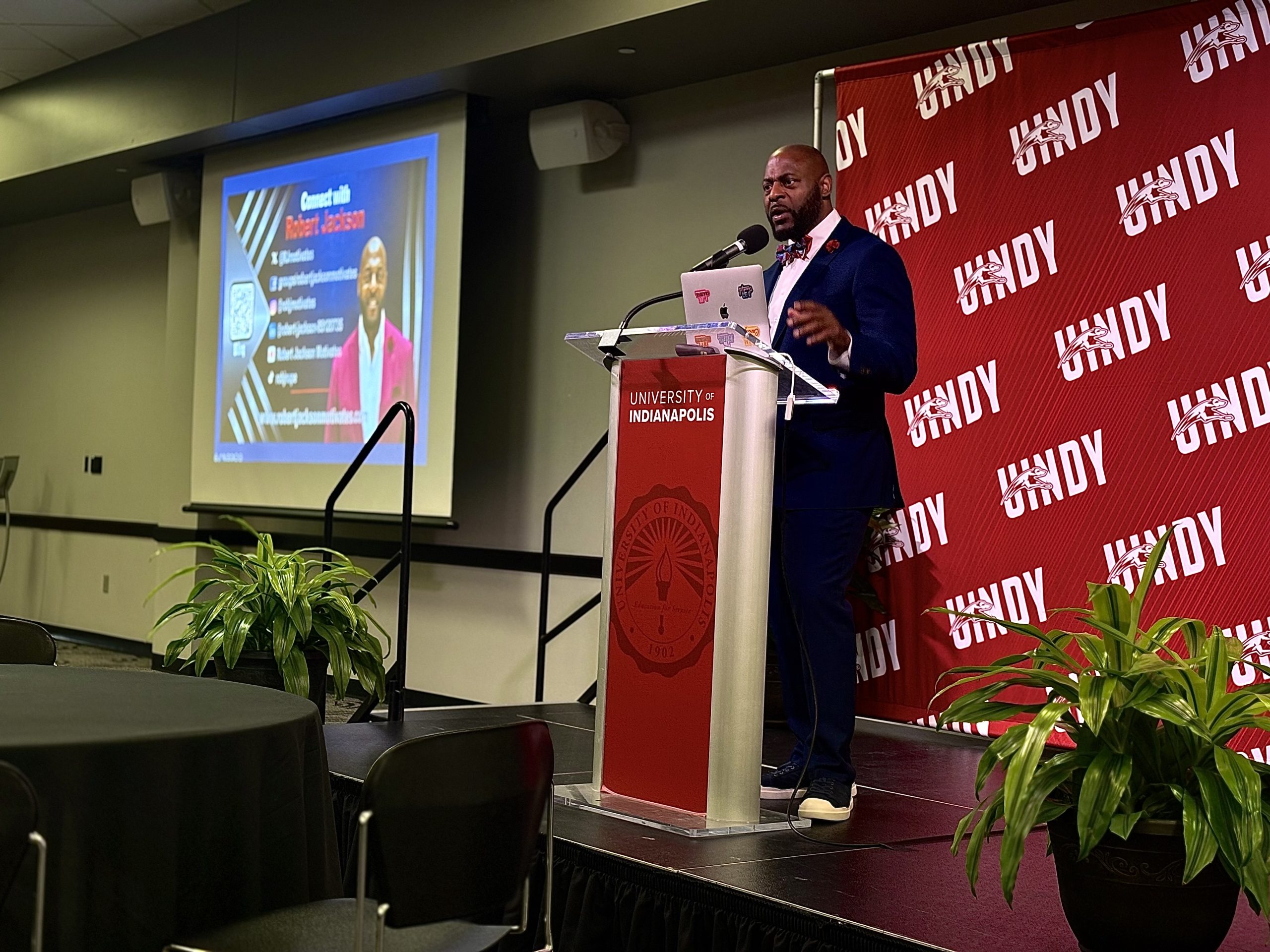
The legacy of Dr. Kate Ratliff — psychologist, advocate and beloved member of the University of Indianapolis community — was honored not just with words, but with a challenge at this year’s memorial conference.
Former NFL player-turned motivational speaker Robert Jackson delivered a powerful and deeply personal message to students, staff and faculty, calling for them to heal.
Ratliff, who taught at UIndy for five years before passing away in 1990, was known for her devotion to her students and her commitment to social justice. The conference, hosted by the College of Education and Behavioral Sciences, highlighted how everyone can follow her example of empathy to help build a better world.
“If we’re going to carry out this legacy of Dr. Ratliff and what she’s done in the past, we’ve got to walk a little bit differently,” Jackson told attendees.
The former Minnesota Viking running back’s professional football career was cut short by a fractured kneecap. He joked that the NFL stands for “Not For Long,” but his transition from professional athlete to educator was anything but lighthearted.
Jackson, a Brightwood native, began teaching in Indianapolis Public Schools more than 20 years ago. He was not prepared for the jump into the classroom. What struck him first was the number of kids who were misbehaving.
“Just so many kids were broken, and I was broken myself,” Jackson said. “Just getting cut from the NFL, dealing with anxiety, dealing with depression. How do you educate, activate and motivate kids when you are dealing with it yourself?”
That is when Jackson started to rethink his life’s work.
Jackson began to master the skills he needed to reach and motivate students. His work eventually led to the creation of the No More Excuses curriculum. Named National Motivational Educator of the Year in 2019, he now travels across the country, helping teachers bring emotional intelligence into their classrooms.
“You’ve been taught to teach math, English, writing, social studies, music and art, but have you been taught emotional intelligence?” asked Jackson.
Jackson, who has experienced his own trauma, including sexual abuse, assault and personal loss, urged attendees to address their problems head-on. During his keynote, he asked audience members to stand if they were personally battling something. In a room filled with dozens, only a handful rose, stressing Jackson’s first step of the healing process: admitting you are in pain.
“If you’re going to heal from it, you’ve got to talk about it,” he said. “We can’t teach healing to children if we can’t heal ourselves.”
The message perfectly captured the life led by Ratliff, who was a licensed clinical psychologist who truly cared and provided support for her students. So much so that she developed a counseling center on campus, which continues to support students’ well-being today.
At the closing of his keynote, Jackson challenged UIndy faculty to recognize the influence and the power they have on their campus.
“You control the temperature, faculty,” stated Jackson. “You control the temperature of future educators. Those four corners of that room, it can be [a] mess on the [other] side of that, but I control the temperature the most.”
At UIndy, Dr. Ratliff’s legacy lives on by shaping educators who teach with both knowledge and heart.
Following the keynote, attendees participated in a series of breakout sessions:
Immigrant Students: Strategies for Social Capacity Building Across the Lifespan
Led by UIndy assistant professors Matthew Stapleton, Hui Zhang and Carin Neitzel of the College of Education and Behavioral Sciences, this session explored how immigrant and international students can struggle to build connections from early childhood through college. Through research in diverse classrooms, presenters demonstrated how immigrant students’ social behaviors are sometimes undervalued and how a strong sense of belonging supports learning and well-being.
Caring and Grief in a Changing World: When Griefbots Take on the Persona of a Deceased Loved One
This session explored the growing use of AI “griefbots”, chatbots created from a loved one’s digital messages and texts that can mimic the way they spoke. Marco Denhert, assistant professor of communication and technology at the University of Arkansas, reviewed the ethical implications of griefbots. Attendees participated in a workshop to see firsthand how griefbots work.
Books as Medicine: The Healing Power of Children’s Stories
In this session, Deedee Cummings, licensed therapist and author, explored how children’s literature supports mental health. Attendees learned how stories help children process emotions, build empathy, and promote well-being.
The conference also included a student showcase, which highlighted the work undergraduate and graduate students have completed through CEBS.
| Presenter | Project Title |
| Morgan Sullivan | Perceived Dangerousness, Voice-Hearing and Public Attitudes toward Coercive Treatment |
| Carson Brinkman | A Review of Readily Available Research on Clinical Behavior Analysis: A Systematic Review |
| Kelsey Altevogt | When Stigma Competes With Context: Cognitive Dissonance in Hiring Decisions |
| Alizaya Londono | ¡Buen Provecho!: An Intersectional Investigation of Disordered Eating Risk Factors in Puerto Rican Communities |
| Megan Feeney | Empirical Investigation of Stereotypes and Stigma Toward Metal Music Fans |
| Samantha Toma | Exploring Parental Expectations Intersection with Acculturation Among First-Generation Egyptian American Women |
| Drayden Gates | Exploring Subjectivity in Poetic Creativity Ratings: A Metacognitive Analysis |
| Mya King | Supporting Trauma in Ayahuasca Ceremony: Training Backgrounds and Trauma Competencies Among Western Facilitators |
| Ainsleigh Cardone | Toward Understanding Authority–Evidence Alignment and Diagnostic Labels in Information Processing and Decision-Making Among Mental Health Trainees |
| Sara Hammerle | Tears in My Paint: Countertransference of Grief in Art Therapists |
| Remington Slayback | Body Doubling and Auditory Stimulation: Predicted Effects on Perceived Focus and Productivity Across Task Demands |
| Yuqi Ji | Evaluating Family Attitudes and Parenting Interventions in Psychosis |
| Anna Trickey | The Emotional Toll of Cognitive Load in Attention-Deficit/Hyperactivity Disorder |
| RSO Representatives | Student Organization Efforts Supporting Education and Behavioral Sciences |
CEBS also accepted donations for Coburn Place, which provides safe housing and supportive services for survivors of domestic violence and their children. Attendees participated in a collaborative art project that will be donated to Coburn Place.